
Newcastle Systems Mobile Workstation Overview
Not sure which Newcastle Cart series will be right for you? No worries, we've got you covered.
To start, use the chart below to determine what level of equipment you will be hosting on the cart.
| Equipment Level @ 8+ Hrs. | Description | |
|---|---|---|

|
Extra Light |
A Laptop, a small thermal label printer and a Scanner or |

|
Light |
A Laptop, a full size thermal label printer and a Scanner or |

|
Medium |
A desktop PC (or a laptop or a micro PC), an LCD Monitor, a full-size thermal printer, and a scanner |

|
Heavy |
A desktop PC (or a laptop, or a micro PC), an LCD Monitor, a laser printer, and a scanner or |

|
Heaviest |
A tower PC, an LCD Monitor, a laser printer, a full size thermal printer, and a scanner or |
Once you've determined your equipment level, you'll want to choose a battery type and configuration.
Currently, there are two types of batteries offered.
The first one is a standard lead acid (abbreviated SLA) battery. This operates like (and in most cases looks like!) the battery used to start your car.
It's main benefit is that it is significantly less expensive. So you can get more power (operate more equipment for a longer shift) for the same budget.
The two disadvantages are that it has a more limited number of recharge cycles (generally around 300) before the battery degrades and holds less and less of a charge. The second limitation is that it should not be fully drained before being recharged. Some manufacturers even set this level as high as 50%.
The second type offered is a lithium iron phosphate (abbreviated LiFePO4) battery. This is like the Lithium Ion batteries in your phone or computer, except for one important factor. By including iron phosphate in the formulation, it is dramatically less likely to succumb to thermal runaway (catching on fire) when damaged or ruptured.
The main advantages over an SLA battery are that it has a much higher expected number of recharge cycles (typically around 2000) and it can be used down to 0% without damage.
The main disadvantage of the LiFePO4 batteries is that they cost significantly more... up front. Over the lifetime of the battery, however, they are often less expensive to operate.
Next, there are two main battery configurations offered. They are "fixed" and "swappable."
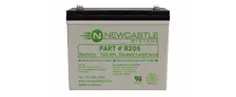
|
Fixed |
A fixed battery is anchored to the cart and therefore, the cart must be moved to a recharging location at the end of a shift and the work shift tailored to the capacity of the battery. For example, an 8 hour shift followed by a 10 your charge cycle. |
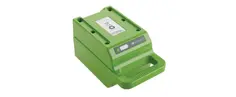
|
Swappable |
A swappable battery can be removed and replaced with a freshly charged battery without having to move the cart back to a echarging area. A work shift can be arbitrarily long (even 24 hours or more), as long as there are enough charged batteries in reserve to swap out. A dual swappable configuration can even continue operation while one of the batteries is swapped out for a fresh one, as long as the equipment connected to it does not exceed the capacity of the remaining battery. |
Once you have decided on the battery type and configuration that will be best suited to your work and budget, it's time to pick a chassis (Series & Model). Here's an overview:
EC Series Carts (Entry Level)
- Designed for lighter-duty applications
- Dimensions: 21" W × 20" D × 43" H (to the top of the table)
- Shelf capacity: 50 lbs. per shelf (evenly distributed)
- Battery platform options support from extra light to lower-medium equipment loads
- Most popular configuration
- Dimensions: 24" W × 26" D × 43" H
- Shelf capacity: 75 lbs. per shelf (evenly distributed)
- Battery platform options support from light to upper-medium equipment loads
- Heaviest construction and largest size
- Dimensions: 30" W × 24" D × 43" H
- Shelf capacity: 400 lbs. in total, evenly distributed over 2 shelves and the base. f
- Larger casters provide improved mobility over rougher surfaces
- Battery platform options support from medium up to the heaviest equipment loads
You will find, in each workstation product page, and also in the configurators linked above, a more complete listing of what equipment level is supported, what the battery configuration is, and what type of battery is included.
Note that you will see some abbreviations where the output and capacity of a battery are stated. Here's an explanation for each:
| SLA | Standard Lead Acid | This is a traditional type of battery chemistry. Behaves like (and frequently looks like!) your car battery. |
| LiFePO4 | Lithium Iron Phosphate | This is a lithium ion type battery (like in your phone), but with iron phosphate chemistry for added safety. |
|
|
||
| Fixed | This means the battery is attached to the cart and cannot be swapped out (except to repair or replace permanently). | |
| Swappable | This means the battery fits in a holster and can be swapped in and out (with a freshly charged one) allowing extended work shifts. | |
|
|
||
| Cont | Continuous Current | This is how much current (in Watts) the battery will support continuously. |
| Surge | Maximum Current | This specifies (in Watts) the peak power draw the battery will temporarily support. |
|
|
||
| W | Watts | A measurement of electrical current. The more watts a peripheral draws, the more energy it’s using. |
| Wh | Watt-Hours | The amount of energy (at a given voltage) that the battery can supply over time. Wh = Ah * Volts. Note that the internal voltage of these batteries vary by type and so Wh will not be an exact comparison. |
| Ah | Amp (Ampere)-Hours | This is an approximation of the total energy capacity of the battery. Ah = Wh / Volts. As with Wh, it is not an exact comparison between batteries because the internal voltage varies between them. |